Why Most Strategies Fail During Execution
Written after years of watching well-designed strategies struggle to leave the boardroom. On alignment, not ideas.


Throughout my career, one thing has been clear: every organisation has a strategy. Whether those strategies are excellent or not is not the point of this article. The real challenge is often not the existence of strategy, but the execution of it.
I have been fortunate enough to work with and learn from brilliant people across different organisations. Many of them contributed to strategies that, on paper, looked strong. They were not just documents. They looked like winning formulas.
Yet despite the thinking, planning and effort that went into crafting them, some still struggled when it came to execution. This leaves me with one question:
Why do most strategies fail during execution?
In many cases, if we look beyond the surface, the strategy itself is rarely the only problem. Most organisations invest significant time and resources into strategy development. The challenge usually begins after approval, when the strategy must move from paper into action.
Research backs this up: execution is normally where failures begin to occur. Harvard Business School professor Robert Kaplan found that 90% of organisations fail to successfully execute their strategies. This is reinforced by further research from the same institution, showing that 67% of well-formulated strategies fail strictly due to poor execution. Damning numbers.
Numbers do not always tell the full story, and in this instance they are merely describing the pattern. My own experience across different organisations points to a simpler explanation, and that is: strategies rarely fail because organisations run out of good ideas. Strategies fail because the organisation and individuals expected to carry out the execution of the strategy were never truly aligned to that strategy.
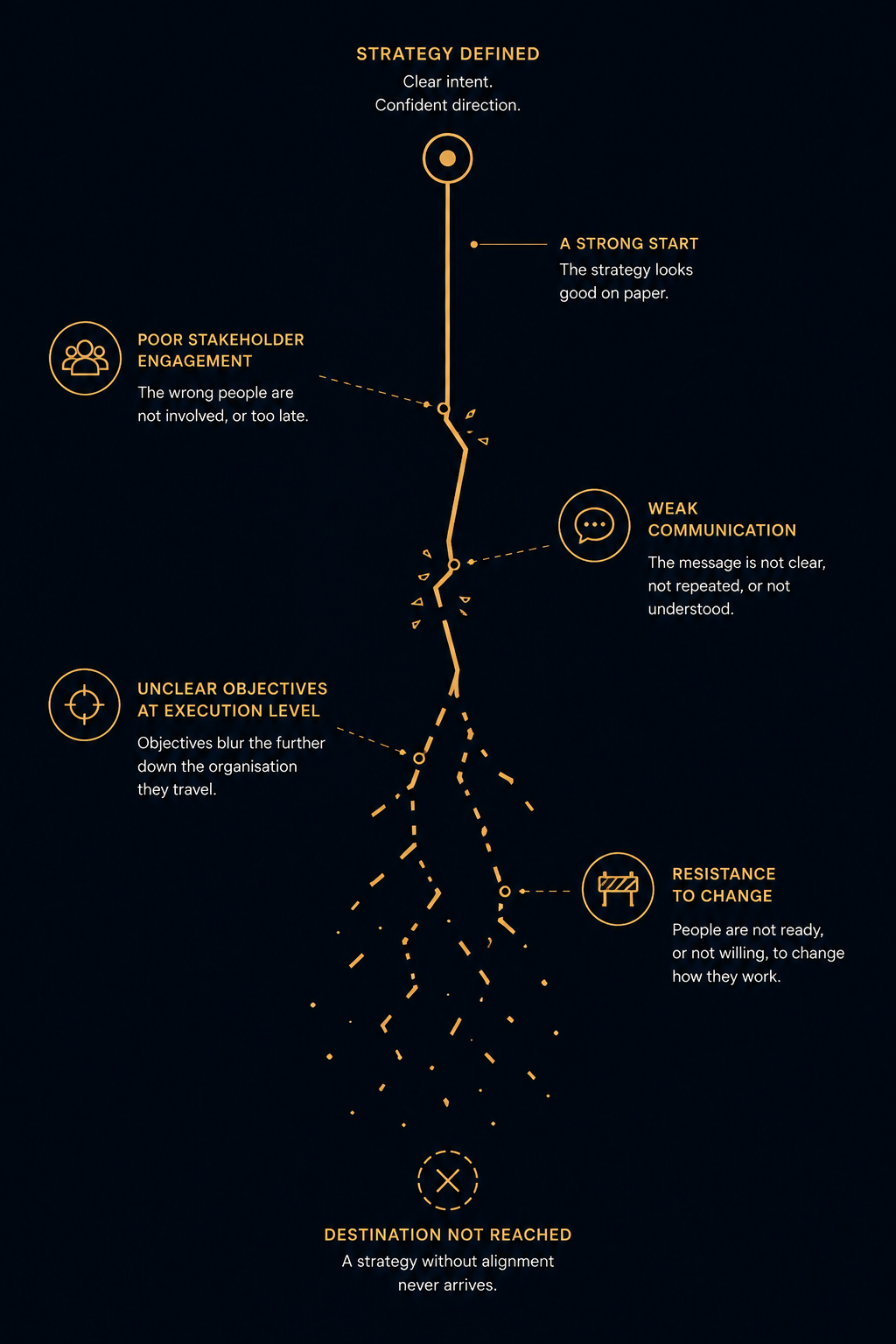
A strategy is, at its core, a set of choices about what to prioritise and what to leave behind. Execution breaks down when the people responsible for carrying those choices through were never brought into agreement on them. Several reasons for that come to mind. One is stakeholders left out of the room. Another is communication that never quite lands, or objectives that blur the further down the organisation they travel. And finally, it looks like change nobody was prepared to accept.
From my experience, that misalignment tends to show up in four recurring ways.
Poor Stakeholder Engagement
Organisations often spend months developing strategy, but when it comes to execution, the very people responsible for bringing it to life are engaged too late.
Too often, strategy lives in boardrooms, executive meetings or strategy offices, while the people expected to implement it receive little more than a presentation, a launch event or a document.
A strategy is only as good as the people who execute it.
Employees need to understand why the strategy exists, what it is trying to achieve, how their role contributes to it, and what success looks like. Without this understanding, execution becomes compliance rather than commitment.
Stakeholder engagement should not begin after strategy approval. It should begin during strategy development, or at the very least, before execution starts. I have experienced being on both ends of this. In one organisation, strategy was cascaded to me as an employee well before launch, with discussions had and feedback collected. In another, I simply sat in a room and was told which direction the company was going. It is not hard to say which strategy I understood better.
Weak Communication
Communication is the bridge between strategy and execution.
One of the biggest reasons strategies fail is that communication is weak. Those closest to the strategy often assume everyone else understands it. In reality, they usually do not. The strategy is not always translated into simple, practical language that employees can understand and apply in their daily work.
Communication should not end after the strategy launch. It should continue throughout implementation, through progress updates, feedback loops, challenges encountered, successes achieved and changes in priorities. In my reading around communication, one idea has always stood out to me, borrowing from the words of Richard Bandler: "The effectiveness of your communication is the measure of the response you get." The emphasis is on the communicator to ensure the message lands, and part of ensuring it lands is repetition. There is a saying I have heard a few times in different forums; I had to research it to find that it came from Zig Ziglar. He said: "Repetition is the mother of learning, the father of action, which makes it the architect of accomplishment." The same philosophy applies here. A strategy heard once at a launch event is, at best, only partially learned.
At one of my old employers, we had a saying which we repeated before every meeting to the point it became like muscle memory: "Safety comes first, value life, value safety." Part of what was expected of us was things like putting your phone away while driving, or always having your seat belt on. The point I am trying to bring across is that the repetition made us learn the expected behaviours. That is simply strategy in action: they managed to get the expected outcome from their staff.
This is to say, the strategies that stand the test of time are the ones repeated and reinforced, in different forms and at different levels, until people move past simply understanding them and start doing something differently because of them. In my experience, larger organisations fall victim to this most, simply because more people need to hear it, and more repetition is required before the message actually turns into action.
When communication breaks down, alignment disappears. People begin interpreting the strategy differently, departments move in different directions, and momentum is lost. A simple test is this:
If a frontline employee cannot explain the strategy in simple language, then the strategy has not yet been communicated effectively.
Unclear Objectives at Execution Level
Another reason strategies fail is that the strategy may be clear at the top but unclear on the ground. This is a different problem from poor stakeholder engagement. An organisation can consult the right people early and still fail here, because getting people into the room and translating the strategy into what it actually means for each of them are two separate jobs.
In most cases, the overall objective is clearly spelt out. The organisation may want to grow revenue, increase market share, gain customers, improve service, grow deposits or launch a new proposition. At that level, the ambition is clear. The problem starts when that ambition is not properly translated for the people expected to execute it.
What does the strategy mean for the officer? What does it mean for the manager? What does it mean for the branch team, the sales team, the marketing team, operations, HR or the back-office teams? More importantly, what should each person do differently because of this strategy?
This is where I believe many organisations struggle. The people expected to translate strategy downwards do not always take enough time to explain it properly. Sometimes they provide half explanations and expect people to run. Sometimes they assume that because the strategy was launched, it was understood.
But hearing a strategy is not the same as understanding your role in it. To try and land this point, I think of the famous American World War I recruitment poster by Uncle Sam, "I Want You for U.S. Army." The objective here is impossible to misunderstand.
America needed people to enlist. The message was short, direct and personal. Uncle Sam did not point vaguely at the population and talk about national mobilisation, military capacity or the strategic requirements of the war effort. He pointed at the individual reading the poster and effectively said: you have a role to play.
That is what good strategy communication should do. The person receiving the strategy should be able to understand not only where the organisation wants to go, but what that ambition requires from them personally. And without that understanding, buy-in becomes much harder.
Imagine a wartime recruitment campaign built around vague language such as "support national mobilisation objectives" or "contribute towards strengthening military capacity." The strategic intention may have been technically correct, but the ordinary person reading it would still be left asking: what exactly do you want me to do?
The Uncle Sam poster left no such ambiguity. We need you. Enlist.
That is the lesson for strategy. People are far more likely to buy into a strategy when they can see themselves in it. They need to know what the organisation is trying to achieve, why it matters, and where they personally fit into making it happen.
A strategy that cannot answer those questions may be clear in the boardroom and still fail everywhere else.
Resistance to Change
Strategies almost always introduce change. New priorities. New ways of working. New expectations.
However, while senior leadership may have spent months discussing the need for change, employees are often introduced to it only when implementation begins. This is where buy-in becomes important.
If the strategy is radical, different or disruptive to what people are used to, it is not enough to simply announce it. People need to understand why the change is necessary, what it means for them, what role they are expected to play, and how success will be measured.
A strategy that took months to research, debate, write and approve may be cascaded to staff in a single event, sometimes in as little as two hours, with the expectation that everyone will immediately understand it, accept it and execute it. But that is rarely how change works.
Cascading a strategy is not the same as managing change. A launch event can create awareness, but it does not automatically create belief, ownership or capability.
I have spent enough time in corporate hallways to hear what happens next. When change management is neglected, the real conversations happen by the water dispenser or over WhatsApp: "Do they even know what they are doing?" "This plan has so many holes." "Why are we changing anyway?" These questions point to a systemic issue. After executive approval is granted, there is almost always a rush to execute, completely bypassing the crucial step of ensuring staff are psychologically ready to absorb the shift.
Without a clear change management process, the strategy may be heard but not absorbed. People may nod in the room and still return to old habits the following week.
People naturally support what they help create. When those expected to execute the strategy have not been involved in shaping or understanding it, buy-in becomes more difficult. Managing change should therefore not be treated as a separate activity. It should be embedded throughout the strategy development and execution process.
In Closing
From my experience, strategies rarely fail because they are poorly designed.
They fail because organisations underestimate what alignment actually requires. Not agreement in the boardroom, but shared understanding all the way down to the people expected to carry the strategy out.
A brilliant strategy cannot compensate for poor stakeholder engagement, weak communication, unclear objectives at execution level, or resistance to change. Each of these is simply alignment breaking down at a different point in the chain.
When people understand the strategy, believe in it, and know the role they play in achieving it, execution becomes far more likely to succeed.
Strategy may define the destination. But alignment, built and rebuilt through people, determines whether the organisation ever gets there.
Founder, author, and curator of The Strategy Lens. He writes about strategy, leadership, marketing, technology, sport, and the lessons life tends to teach the hard way. He is also developing Axis Strategy Lab, an advisory venture extending these ideas into practice.
More about James →