Better Decisions Begin With Better Questions
Written on curiosity, discipline, and the habit of asking one more question. On wonder as the start of strategy.

I remember sitting in my philosophy classes and always being impressed with how ancient philosophy originated and developed. One of the few lectures that stayed with me dealt with the sense of wonder. There is a long philosophical tradition that treats questioning as the beginning of understanding. Socrates built his method around questions. Plato, his student, preserved this spirit through dialogues where inquiry was central. Aristotle, who studied under Plato, would later argue that philosophy begins in wonder: the idea that human beings seek knowledge because something first captures their curiosity.
Before we understand, we first wonder. Before we learn, we first ask.
That idea has always stayed with me.
For those who know me properly, I am not ashamed to say that Google is never far from me. I will search for anything I do not understand. A word. A concept. A business model. A football tactic. A regulation. A phrase someone used in a meeting. Sometimes it is simple curiosity. Sometimes it is me testing my own thinking, trying to strengthen a position I already hold or challenge it. But one thing holds true: pretending to understand something is one of the fastest ways to make poor decisions. If I truly do not understand, I ask. And if it is something I can learn on my own, I try to do so.
Over time, I have come to appreciate that questioning is not a sign of ignorance. It is often a sign of seriousness.
Why Questions Matter in Strategy
In strategy, this matters even more.
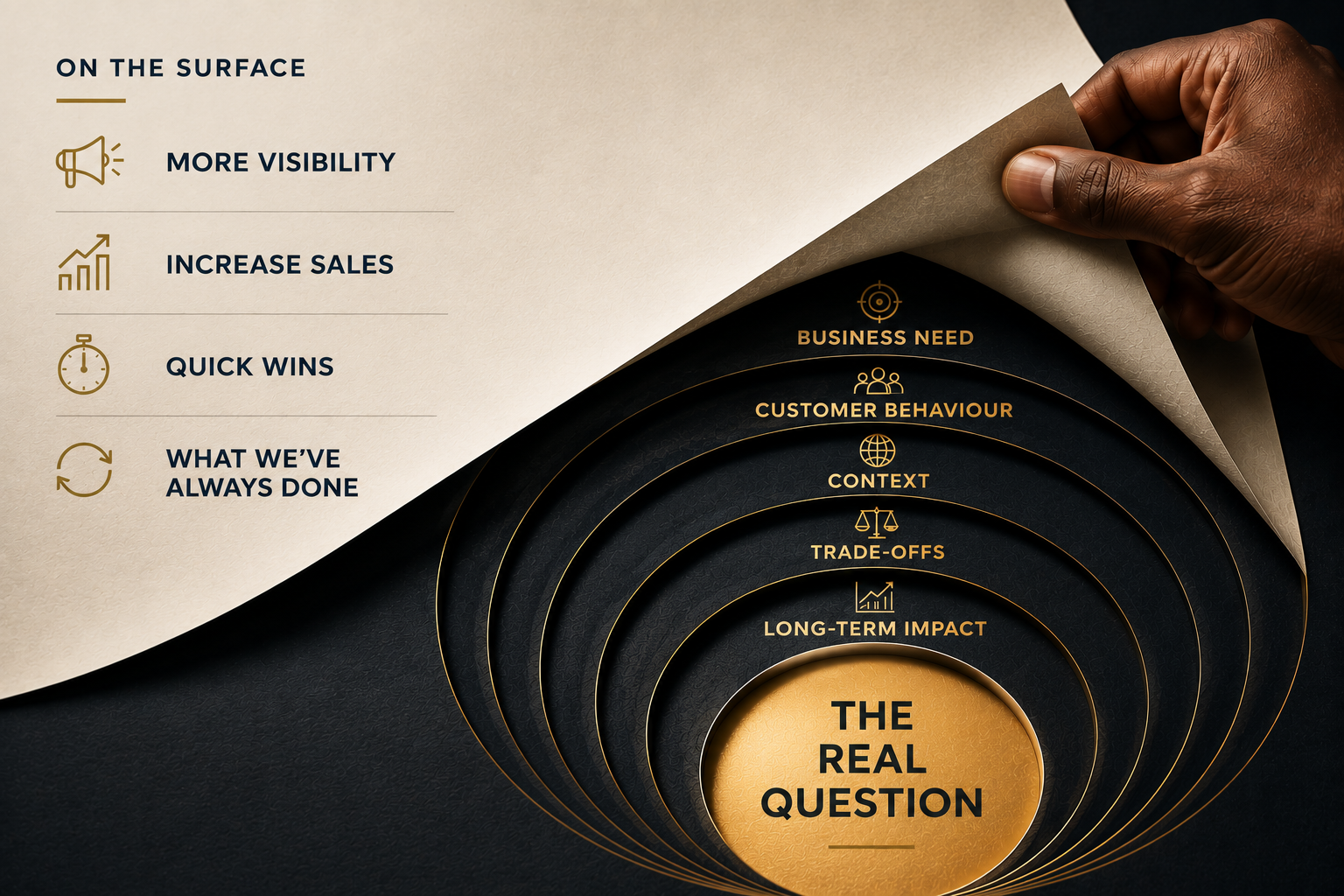
Many organisations rush toward answers. We want the campaign. The project. The budget. The launch. The activity plan. The announcement. The quick win. But the quality of the decision is often limited by the quality of the question that came before it.
One thing I learnt from a former line manager was this: "Always ask why if you want to get to the bottom of everything." He would say, "If someone can answer the question why five times and not get annoyed or offended by the repeated questions, that person is usually telling the truth, or they simply know what they are talking about." But "why" is just the beginning of it.
A weak question produces a shallow answer. A better question forces clarity. And even though the question may not always be "why," it should bring clarity to what one is trying to achieve.
Instead of asking, "What campaign should we run?", marketing teams may need to ask, "What customer behaviour are we trying to influence?" Instead of asking, "How do we increase visibility?", we may need to ask, "Visibility among whom, for what purpose, and what should they do after seeing us?" Instead of asking, "What are our competitors doing?", we may need to ask, "Which competitor actions actually threaten our position, and which ones are just noise?"
In all of these, there is a "why" embedded. Why this campaign? Why this audience? Why this action? Why now?
This is where strategy begins.
Strategy Is a Set of Choices
Strategy is not simply a plan. It is a set of choices. And choices require trade-offs. You cannot make good trade-offs if you have not asked the right questions.
A weak question produces a shallow answer. A better question forces clarity.
A good strategic question helps an organisation separate activity from progress. It forces teams to move beyond "What are we doing?" and ask "Why are we doing it?" and "How will we know it worked?"
In simple terms, from a marketing perspective, we move from looking at the business need or problem, to developing a business case, to identifying the expected outcomes, and then considering the longer-term benefits. Together, these create the scope of the plan and provide a clearer blueprint for execution.
This is also true in execution, whether one is looking at a marketing campaign, a sponsorship, a business project, or an internal initiative. Many projects struggle not because people are lazy or incapable, but because the initial questions were too weak. Teams may agree on deliverables before agreeing on the problem. They may create timelines before confirming dependencies. They may assign responsibilities before understanding stakeholder expectations. In marketing, the same thing happens when teams rush to visibility before understanding the audience, the desired behaviour, or the business outcome.
A campaign can be visible and still fail. A sponsorship can be popular and still lack strategic value. A project can be completed and still not solve the real problem.
That is why the questions at the beginning matter. What problem are we really solving? What outcome are we trying to deliver? Who are we trying to reach or serve? What does success look like?
Answering those four is only half the work. The other half is uncomfortable: who owns the outcome, what assumptions are we quietly making, what could delay us, and what would make this work meaningful rather than merely active?
These questions may seem basic, but basic does not mean unimportant. In many cases, the obvious questions are the ones teams avoid because everyone assumes someone else has already answered them. Better questions at the start can prevent confusion, rework, weak execution, and wasted effort later.
Leadership and the Cost of Silence
The same applies to leadership. Good leaders do not need to pretend to have every answer. In fact, some of the strongest leaders are those who create environments where better questions can be asked without fear. They understand that silence in a meeting does not always mean agreement. It may mean confusion, fear, disengagement, or a lack of ownership. I have been in scenarios where all of this was true. I mistook the silence for alignment, only to realise later that people were confused, disengaged, or unconvinced.
A leader who asks better questions gets better information. And better information improves decision-making.
The Danger of "We Have Always Done It This Way"
One of the most dangerous phrases I have come across in the organisations I have worked in is, "We have always done it this way." It closes the door to inquiry. It assumes that past success automatically justifies present action. But environments change. Customers change. Competitors change. Technology changes. Economic conditions change. What worked before may no longer be enough.
Better questions help organisations remain honest. They help us test assumptions. They help us challenge comfort zones. They help us identify whether we are solving the real problem or simply responding to symptoms.
From Blame to Diagnosis
When something goes wrong, the difference between an easy question and a better question is often the difference between blame and diagnosis.
Easy question: Why are sales down?
Better question: At what point in the customer journey are we losing people?
Easy question: Why did people not respond?
Better question: Did we understand the audience well enough before designing the message?
Easy question: Who failed to deliver?
Better question: What dependency or decision was not properly managed?
Better questions shift us from blame to diagnosis. They move us from reaction to understanding.
They help us make decisions based on insight rather than emotion, pressure, or imitation.
Discipline Begins With Questioning
This matters because not every opportunity deserves a response. Not every competitor move requires panic. Not every trend deserves investment. Not every idea deserves execution. Strategy is as much about what we choose not to do as what we choose to pursue.
And that discipline begins with questioning.
Before we approve the budget, we should ask whether the investment supports the strategy. Before we launch the campaign, is the audience insight actually clear? Before starting a project, has the problem been properly defined? And before we copy a competitor's move, we should ask whether it even fits our own strategic position, not just whether it worked for them. Before we celebrate activity, the real question is whether it created progress.
Thinking Properly, Not Overthinking
This is not about overthinking. It is about thinking properly.
I have been fortunate enough to work for some of the best brands in the country, and for some of the best line managers. Another lesson I will never forget came from a conversation with the then Country Manager at Unilever, a brilliant individual. I came to her with a proposal, and her response was, "James, all that sounds nice, but I do not deal with English and nice words. I prefer you give me the numbers and a plan which justifies what you are telling me."
The lesson was clear: strategy cannot survive on good language alone. It needs evidence, numbers, logic, and a plan.

There is a difference between asking questions to delay action and asking questions to improve action. The goal is not to analyse forever. The goal is to act with greater clarity.
In a fast-moving environment, speed matters. But speed without clarity can be expensive. A team can move quickly in the wrong direction and still feel productive. Better questions help ensure that when we move, we are moving with purpose.
Where Better Strategy Begins
Personally, I have found that curiosity has become one of the most useful habits in my professional life. The willingness to ask, search, read, test, and understand has helped me see connections between marketing, strategy, customer behaviour, project execution, leadership, and business performance.
The more I learn, the more I realise that good decisions rarely come from having all the answers at the beginning, but from truly understanding the problem at hand and finding the right solutions for it.
That is where better strategy begins.
Not with noise. Not with assumptions. Not with imitation. Not with activity for its own sake. But with the humility to pause and ask the right questions.
Because in the end, better decisions begin with better questions.
Founder, author, and curator of The Strategy Lens. He writes about strategy, leadership, marketing, technology, sport, and the lessons life tends to teach the hard way. He is also developing Axis Strategy Lab, an advisory venture extending these ideas into practice.
More about James →