Radio, Someone Still Loves You
Inspired by Queen's Radio Ga Ga, forty-two years on. On channels, choice, and mistaking your own habits for your customer's.

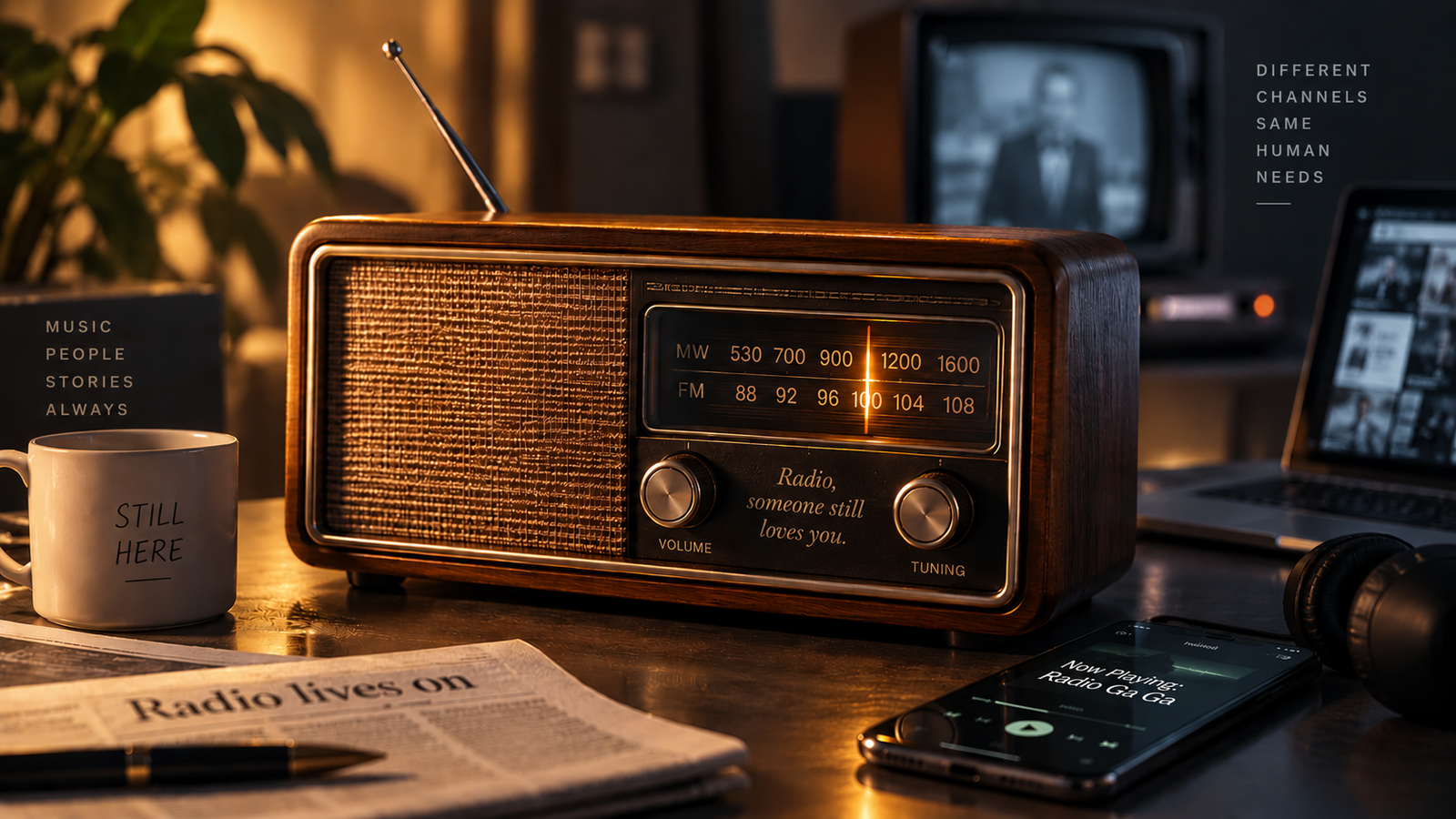
Let me paint a picture.
It's 1983. Roger Taylor is with his son Felix in Los Angeles, driving home listening to the radio, and a song plays. Felix, the son, exclaims, "radio ca ca." This little moment sparked an idea in Roger, one that would eventually become one of Queen's most recognisable hits. Now here I am, 43 years later, at home in my living room listening to music, and I play Radio Ga Ga. For the first time I am actually paying attention to what Freddie Mercury is trying to say, and upon listening closely my own mind starts exploding with creativity.
In 1984 the song was released, and the message is clear. Queen was mourning radio. MTV and music videos were becoming bigger and bigger, and the thought was that TV was overshadowing radio.
Now, I had not existed yet, but there is a line in the song, "my only friend through teenage nights and everything I had to know, I heard it on my radio." The line beautifully captures the time, and I could relate in some way to Roger's nostalgia, from listening to actual radio stations, to playing cassette tapes of our favourite artists. Everything we knew, we knew through radio. Well, maybe not everything. Newspapers existed too. It makes you pause and realise every medium has its limits.
But the point here is that radio held immense power. It was how people discovered music, followed what was happening around them, and more importantly for marketers, how brands reached enormous audiences.
MTV threatened this position. The rise of MTV changed not only how people started looking at music, but how music itself was consumed. It was no longer enough for a song to sound good. Music now had a visual component.
Despite all of this, Queen themselves may have understood this better than most. Their music videos became part of how we remember music. But this article is not about whether music should be listened to or watched. It's about marketing and its channels. 43 years later, Queen's fear has not quite come to pass.
In their own words, "Radio, someone still loves you," and this is still true today.
We've Seen This Before
The rise of music videos did come.
In 1981 MTV launched and changed the landscape in the way music was discovered and consumed. But when you look at the pattern, the disruptor also eventually gets disrupted.
The internet came, and then YouTube arrived in 2005, and suddenly we didn't need to wait for MTV to decide which music videos we could watch.
I remember sitting watching DSTV and waiting on MTV (TRL) to release the latest music videos. Every time they were released, it was an event. When I had to sit and wait to watch Jay-Z's Unplugged on MTV, those were all events which live in memory and remind me of how powerful MTV was during those times.
Streaming followed, giving us the ability to choose almost any song we wanted, whenever we wanted it. Then social media changed discovery again. Nowadays a song can find its audience through a few seconds of a TikTok video before that person has ever heard it on radio.
Each new arrival changed the position of what came before it.
But interestingly, very few completely killed what came before.
Radio, Television, YouTube, Streaming, Social Media, they are all still here. The audience simply has more choices.
The Beauty and Dangers of Choice
Here I am, sitting in my room, thinking about the beauty of the song and the diversity of options we now find ourselves with, and one thing becomes clear.
It creates a beauty in how marketing can reach its audience. DSTV had a famous campaign called "Get Used to Choice," and it's worth keeping that in mind as I frame my argument. DSTV's idea was simple: we are not all the same, and there was content for every member of the family. Even within similar content, it would be split according to preference, football with different leagues to choose from, or those interested in documentaries also having a wide net to choose from.
This takes me back to the simple idea of marketing: understanding customer wants and providing products and services which cater to them.
To ignore this basic principle is essentially to ignore your audience. And I think sometimes we do exactly that. Not intentionally, but sometimes we assume that our own behaviour represents the behaviour of the people we are marketing to.
I don't listen to radio, therefore nobody listens to radio.
I don't watch television, therefore television is dying.
I spend my time online, therefore everyone else must be doing the same.
But that isn't how markets work.
The world has billions of people. Even within one country, there are differences. In a family, there are differences; preferences still appear.
The fact that a channel is no longer important to me does not mean it is no longer important to my customers. It's something I always think about when we discuss preferences. I have young friends, mind you, working, functional adults in their thirties, telling me, "James, you are showing your age, you're old," simply because of the preferences I have.
But in the end, these differences matter.
Bring It Down to Malawi
If I bring this down to Malawi, the argument becomes even more interesting. Malawi's population is projected to be approaching 23 million people in 2026. At face value, that sounds like a very big market. But companies are not competing for 23 million people. To paint a picture, let's break this number down.
Almost half the population is under 18. About four in every five Malawians live in rural areas. That immediately changes the commercially addressable audience for many products. Take banking as an example. The 2023 FinScope Consumer Survey estimated Malawi's adult population at approximately 11.3 million. Yet only 13 percent of adults, roughly 1.5 million people, were banked. That does not mean the remaining adults are commercially irrelevant. They represent an important future market. But they are not all immediately reachable, eligible, or able to use every product being advertised.
Income reduces the audience. Formal employment reduces it further. Geography, documentation, product eligibility, and access to a service point reduce it again. Then we come to communication. Malawi may have millions of mobile subscriptions, but subscriptions are not people. One person can own several SIM cards, while another owns none. The 2023 National ICT Survey found that only 56.6 percent of individuals owned a mobile phone. Among those who owned one, just 36.3 percent owned a smartphone. Internet usage is smaller still. Estimates for the beginning of 2025 placed Malawi's internet-using population at approximately 3.95 million, about 18 percent of the country.
And social media audiences are even smaller than that.
Suddenly, the eight banks, three mobile operators, insurance companies, retailers, betting companies, politicians, and everyone else advertising in Malawi are not each speaking to 23 million people.
They are fighting over slices of slices of slices.

The Numbers Still Matter
In addition to this, every year we conduct research on TOMA, Top of Mind Awareness, and there is something interesting I have noticed over time.
When I look at the brands that consistently perform strongly on TOMA, many of them are also brands that spend significantly on radio.
Now, I am not saying they lead TOMA because they advertise on radio. There are obviously many things that build brand awareness, and without isolating the impact of each channel it would be wrong to make that conclusion.
But I also don't think the relationship should simply be ignored.
And the numbers show that the audience is still there.
The 2023 National ICT Survey found that MBC Radio 1 was listened to by 36.3 percent of individuals, Zodiak by 30.5 percent, and MBC Radio 2 by 26.7 percent. The numbers cannot simply be added together, since respondents could mention more than one station, but they show that individual radio stations can still command significant audiences in Malawi.
The wider African picture tells a similar story. Recent Afrobarometer research found that 59 percent of people across 38 African countries get news from radio every day or a few times a week.
That is probably enough data.
Because the point isn't that radio is better than digital.
It isn't.
Digital gives us targeting, measurement, interaction, and capabilities traditional media could never provide in the same way.
The point is much simpler.
If a meaningful part of my audience is still somewhere, my own preference is not a good enough reason to stop talking to them there.
And that takes us back to the customer.
Preference Is Not Strategy
Some audiences may not want to move, and their preference is still their preference.
The examples are everywhere.
Because the point isn't whether my preferred platform is fashionable.
The point is that people have preferences.
As marketers, once we begin assuming everyone behaves like us, we begin making decisions based on ourselves instead of the customer.
And in marketing, to ignore the customer is essentially to ignore your business.
Perhaps this is the mistake we make when we declare channels dead.
We confuse declining dominance with irrelevance.
Radio, Television, and Newspapers certainly do not occupy the position they once did. And one day the platforms we currently believe are untouchable will probably face their own challengers, disruptors being disrupted.
That does not automatically make any of them useless.
The question should always be: Who am I trying to reach? Where are they? What are they doing there? And what is the most effective way of reaching them? Just like DSTV, think about your customer and provide them with what they are looking for.
Radio, Someone Still Loves You
This article is about how, as time passes and the world evolves, we can get caught up in the next big thing and "move with the times," while forgetting how some audiences may not want to move, and their preference is still their preference. The examples are everywhere. Take the group of friends who laugh at me for the social media channels I use, reminding me of my age. It ties in to the point I am trying to make here: that as trendy and as current as we try to be, we also have our preferences, and in marketing, to ignore this is to essentially ignore your business.
Queen could have done the same and said, "We will only do the music for radio," but they understood the times were changing, and there was an audience they could reach despite their preferences.
So just like Queen, all the channels we use as marketers have had their time. They are yet to have, or have had, their finest hour, but regardless, someone out there still loves them.
Founder, author, and curator of The Strategy Lens. He writes about strategy, leadership, marketing, technology, sport, and the lessons life tends to teach the hard way. He is also developing Axis Strategy Lab, an advisory venture extending these ideas into practice.
More about James →